Opera Australia | Madama Butterfly
3 January 2026, Sydney Opera House, NSW
Opera Australia opened its 70th anniversary year with a confident, crowd-pleasing return to Madama Butterfly, presenting a production that wears its history proudly while speaking clearly to the present. Opening night at the Sydney Opera House carried extra charge: it was announced that the principal Pinkerton had had to withdraw, with Diego Torre stepping in at short notice – it was news that might have unsettled some companies, but Torre demonstrated just how deep Opera Australia’s bench of professional talent is.
A quick synopsis: Madama Butterfly tells the story of a (very) young Japanese woman who waits faithfully for the return of her American husband, only to discover he has abandoned her and intends to take their child, leaving her with a devastating final choice.
This revival of Moffatt Oxenbould’s much-loved 1997 staging remains visually arresting. From the outset, the production is unmistakably Japanese in its aesthetic language: stylised, colour-coded and perfectly, even meticulously, choreographed. Servants in white, Suzuki in green, ancestors and relatives in blue, Butterfly’s entourage in wild pinks – each group moves with ritual clarity, allowing your eye to pick up on the social structure immediately. It is beautiful, precise, and nothing feels arbitrary.
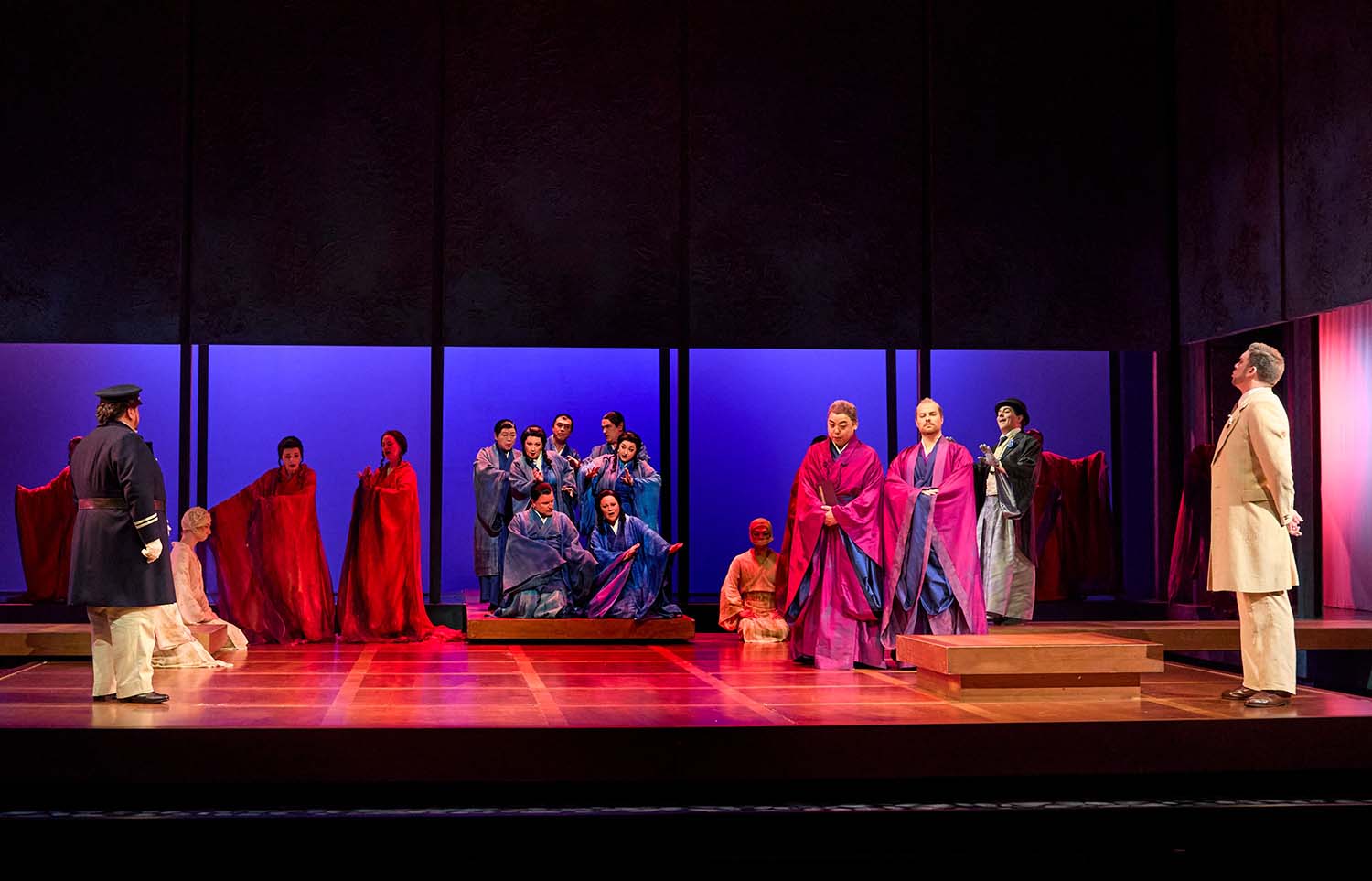
The reveal of Butterfly’s house is one of the production’s great theatrical moments. Sliding panels open and close like a breathing organism, surrounded by a narrow moat that at first suggests illusion, until a servant steps into it and we realises the water is real! Used sparingly and symbolically, it becomes a visual marker of class and labour: servants pass through it; principals never do. Later, tea lights float across its surface, stars reflected below as well as above.
Musically, the evening was superbly paced under the baton of Andrea Battistoni, tonight announced as Opera Australia’s incoming Music Director. The orchestra played with colour, tension and a strong sense of the theatre going on above them. Puccini’s Japanese-inflected music with its pentatonic figures, bell colours, even the pointed intrusion of The Star-Spangled Banner, was handled with finesse.
At the centre of it all was Cio-Cio-San, sung with remarkable vocal poise and emotional range by Guanqun Yu in her OA debut. Her Butterfly was youthful, hopeful and luminous. The famous Act I love duet unfolded with great balance as the two voices blended with ease, as though they had been rehearsing for weeks. Battistoni and the superb lighting design held us in awe but so taken was the audience that the bravos erupted before the final resonance had fully faded.
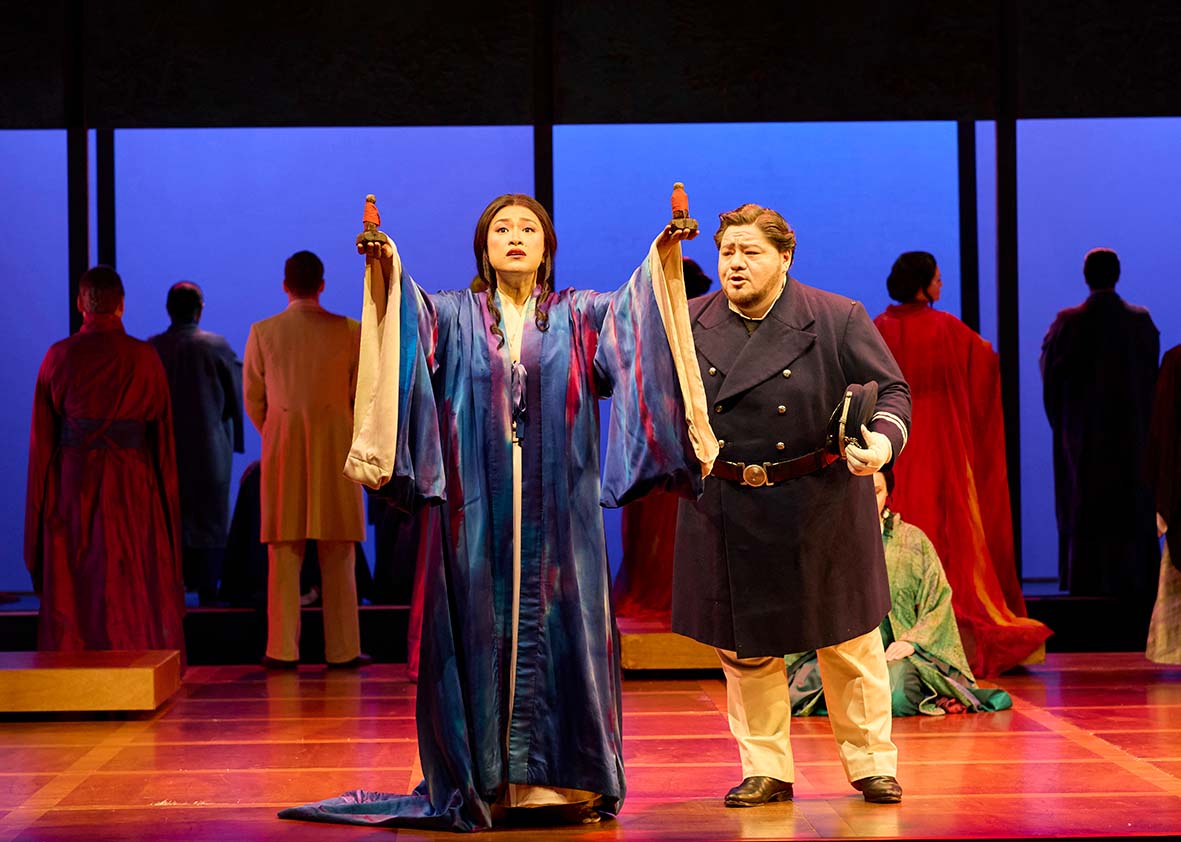
Torre’s Pinkerton was sung with clean, ringing tenor tone and dramatic commitment. If he was still booed at curtain call, it was not for lack of musical conviction, but because the character now lands squarely as what he is: entitled, careless and morally reprehensible. That response feels like a sign of our times, and of a production that refuses to soften the truth.
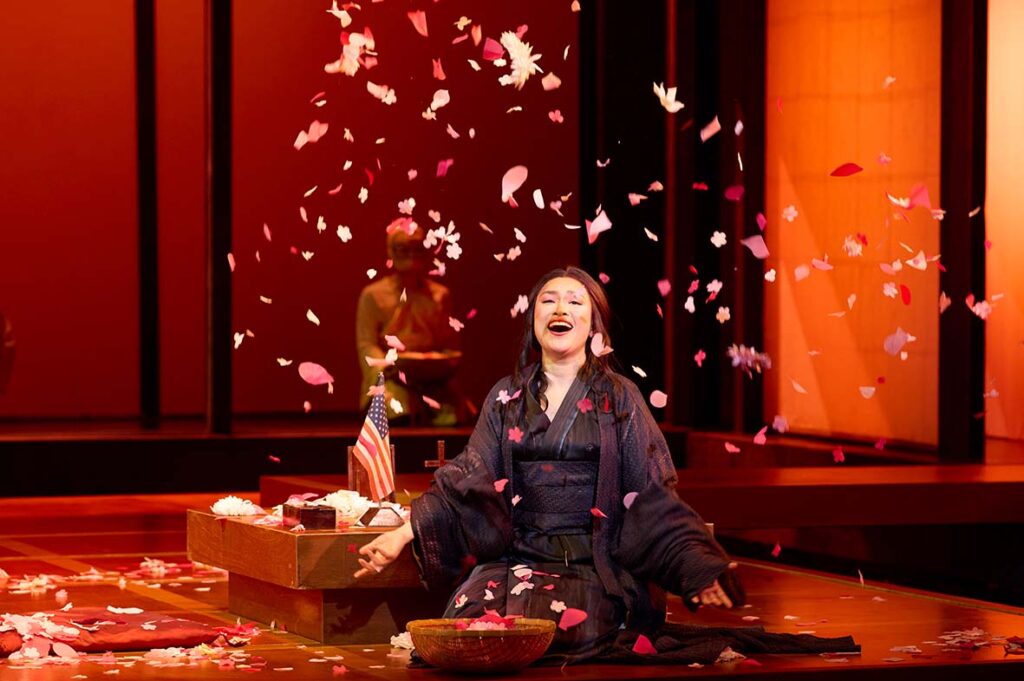
Act II delivered its visual coups with devastating effect: the flower scene, petals cascading from above as Butterfly and Suzuki sing in rapturous hope; the long vigil, underscored by hushed choral humming; the imperceptible shift from night to dawn through masterful lighting and moving architecture. Even knowing the ending, one still hopes, against reason, that this time it might end differently.
It doesn’t, of course. Butterfly’s final act is framed as a choice governed by honour, tragic and irrevocable. The ovation that followed was immediate and unanimous.
As an opening statement for a milestone year, this was a hit: a legacy production performed with assurance. If this is how the company intends to mark its 70th year, the season ahead looks promising indeed.