Sydney Mozart Society |Timo-Veikko Valve & Aura Go
19 August 2025, The Concourse, Chatswood, NSW
Program
BEETHOVEN: Horn Sonata in F major, Op.17 (arr. Beethoven)
MOZART: Andantino in B-flat major, K 374g (cmpl. Annette Isserlis)
MOZART: Allegro in A major, K 480a (cmpl./arr. Ian Munro)
MOZART: Andante and Fugue, K 402 (cmpl. Maximilian Stadler, arr. Ian Munro)
LISA ILLEAN: ever-weaver
SCHUBERT: Sonata in A minor, D.821 Arpeggione
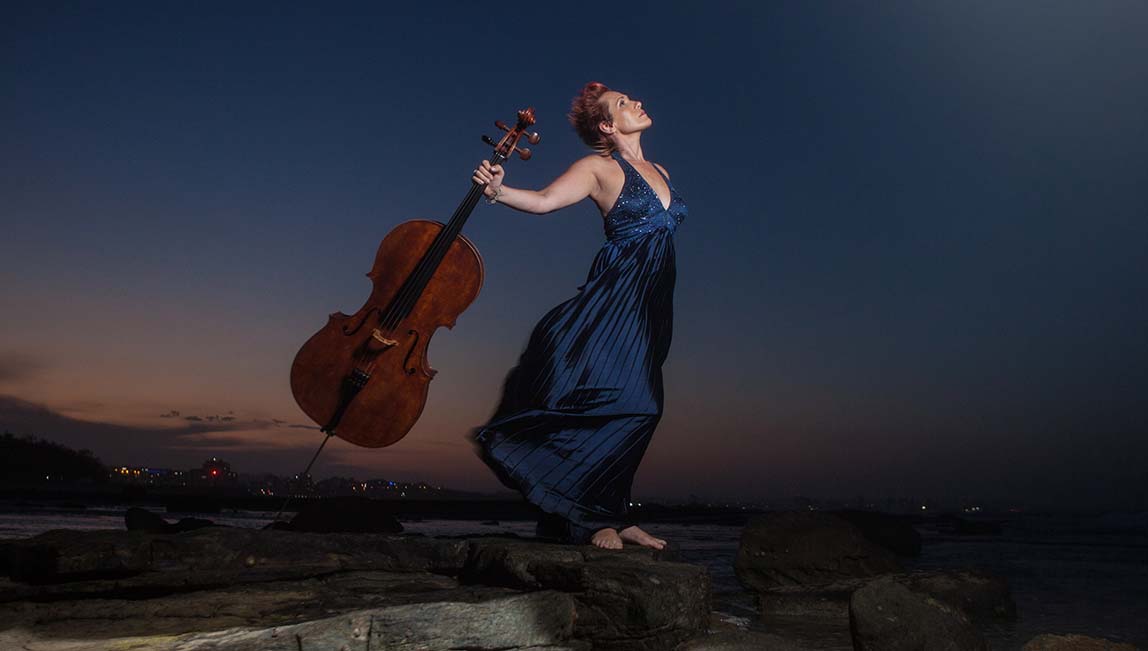
The Sydney Mozart Society mostly enjoys its Mozart pretty straight, but this is not what was on offer here. Timo-Veikko Valve, the principal cellist of the Australian Chamber Orchestra, and Aura Go, Head of Piano at Monash University, presented a program of arrangements and unfinished fragments completed by others.
Beethoven arranged his own Horn Sonata for Cello some years after writing the original work. The horn he wrote for was a “natural” horn; the fully chromatic instrument with valves had not been invented yet. The natural horn is pretty much limited to the harmonic series which, in early brass instruments, typically generated fanfare-like or hunting call-like melodies. Beethoven rewrote the work for cello to make it more accessible to the public, but he also used the opportunity that the chromatic stringed instrument afforded him, smoothing out awkward leaps and making full use of the more expressive possibilities. So we heard a work which was more lyrical, expressive and one which allowed for a more nuanced interaction with the piano. Timo-Veikko Valve played with energy and a lyrical warmth that did justice to Beethoven’s rewriting. Aura Go was technically accurate, but more than that, clear in texture and articulation, and with emotional understanding; a bedrock for the cello’s expressiveness.
It seemed a bit strange that Valve positioned himself with his back to the pianist, allowing for no eye contact between them and projecting the cello sound away from his musical partner. Also the keyboard was thus obscured from the audience’s view. It would have been better if he sat slightly side-on in front of the crook of the piano. Fortunately it did not adversely affect their ensemble playing; like all good musicians they communicated well aurally.
Mozart completed no sonatas for cello and piano at all, which is surprising. He left us just a very incomplete exposition sketch, the Andantino in B-flat major. Mozart probably intended this gentle, lyrical piece as a small scale work rather than a full sonata, but for whatever reason he never finished it. British music scholar Annette Isserlis used the fragment to create a short but expressive piece in Mozart’s style and it works well. It is impossible to know where Mozart ends and Isserlis takes over.
The two remaining Mozart fragments, the Allegro and the Andante and Fugue, were completed respectively by Ian Munro and Maximilian Stadler. Neither of the works were for cello and piano, and neither were in A major. Munro, who is quite the Mozart scholar, arranged them as such and this is how we heard them today, reimagined and performed as a single cello sonata. Munro as composer and Valve and Go as performers breathed new life into these works and rendered them more accessible.
In the second half of the concert, works were again concatenated, but this time two compositions of a very different ilk. “Ever-weaver” by the UK resident Australian composer Lisa Illean is a work inspired by the delicacy of a spider’s web. It is rhythmically simple but reminiscent of Schoenberg’s Klangfarbenmelodie, where the tone colour of relatively sparsely sprinkled notes form the musical interest rather than lyrical phrases. This evocative work served as a slow movement introduction to totally different work. Schubert’s Sonata in A minor, D.821 was written for a newly invented instrument, the Arpeggione. It was a bowed instrument with 6 strings, fretted and tuned like a guitar (E–A–D–G–B–E) whose purpose was to bridge the chordal possibilities of the guitar with the expressiveness of the bowed cello. The instrument fell into obscurity within a few decades but Schubert’s sonata was worth saving. It was resurrected in 1871 as a cello or viola sonata. It does however present problems for the performer; playing a work for an instrument with 6 strings tuned in 4ths causes all manner of fingering issues on a 4 string instrument tuned in 5ths. There is a recording available on YouTube of the original Schubert sonata played on the arpeggione if you are interested (linked here >>). At any rate this lyrical work is these days mostly played in the cello arrangement and as Valve demonstrates, on the cello it affords much greater strength than the rather more gentle arpeggione.
This concert is not the usual fare for the Mozart Society but in the hands of these consummate performers, life was breathed into the rather obscure and rarely heard works. A satisfying program for the musically curious.