Canberra International Music Festival | Pianos & Percussion: Festival Finale
3 May, 2026, Snow Concert Hall, Red Hill, ACT
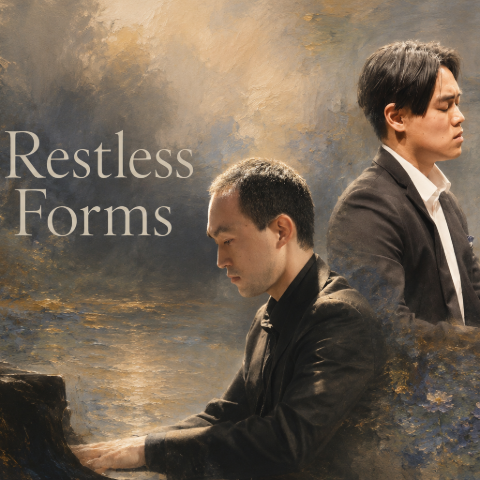
The Canberra International Music Festival drew to a close in the Snow Concert Hall with a program that felt very true to the overall spirit of the festival — ambitious, diverse and immersed in culture. With lawns outside inviting a glass of wine in the sunset, and one of the city’s finest acoustic spaces inside, this finale brought together pianists Kristian Chong and Timothy Young with percussionists Eugene Ughetti, Kylie Melville and Veronica Bailey for a program that traced rhythm, movement and dance across a century of music.
It opened with Sergei Rachmaninoff’s Symphonic Dances in its two-piano form — a reminder that even without orchestra, this music carries enormous weight. Chong and Young navigated its shifting tempos and rhythmic drive with wonderful clarity and control, allowing the dance-like energy of the work to emerge in clean lines and muscular phrasing. Stripped of orchestral colour, the piece revealed its structure – less lush perhaps, but still compelling. It made me listen differently.
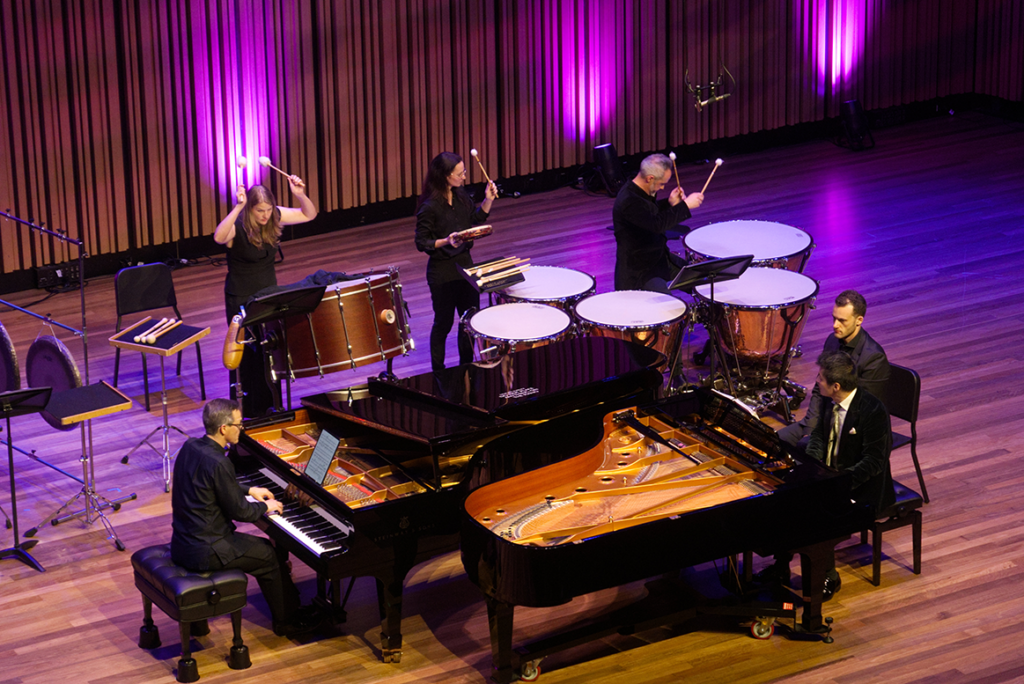
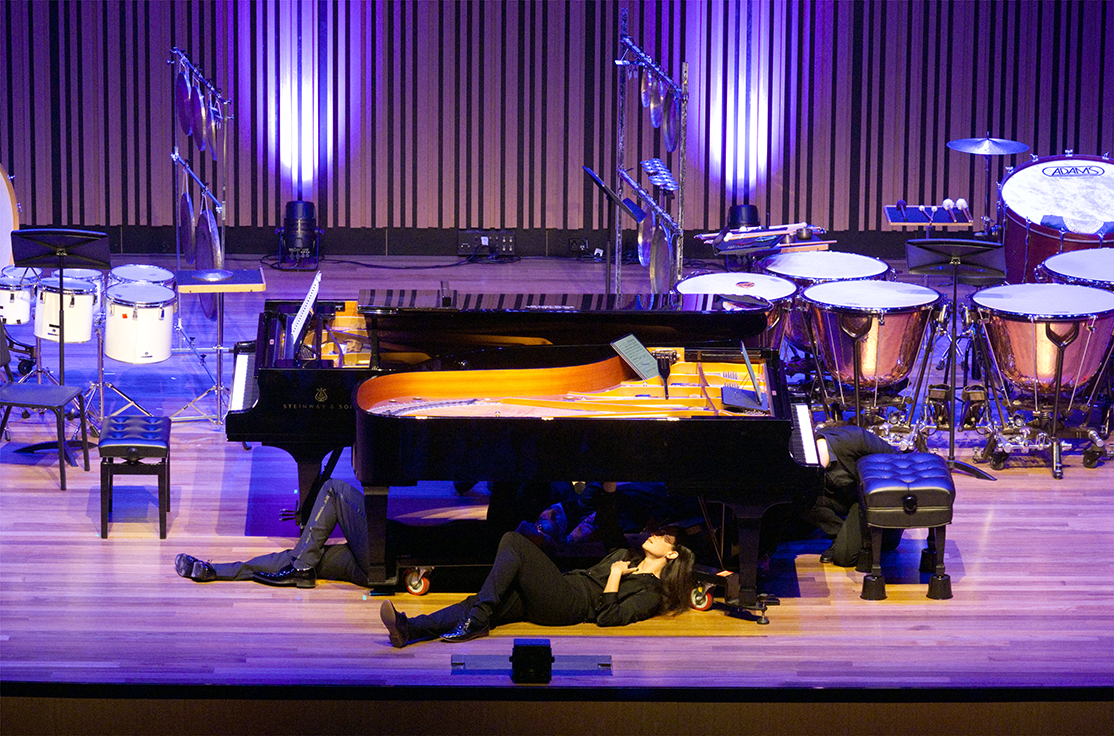
The world premiere of Australian composer Fiona Hill’s festival commission, If only we could listen, for two pianos and two percussionists this was as much physical theatre as it was music. The stage was alive with motion. Ughetti and Melville moved constantly between instruments, matching the pianists in both intensity and presence. Crotales flashed with rapid precision, gongs shimmered and the pianos surged with sweeping glissandi and bursts of drama. At times, the piano itself seemed less a melodic instrument and more a percussion instrument — high trills struck like sparks, while inside the instrument, strings were plucked and struck producing eerie, resonant sounds. It was unmistakably contemporary. Fragments of an ‘unhinged waltz’ surfaced and dissolved, as if something once stable was struggling to hold its shape. Within the density, there were moments that asked for stillness — an invitation by the composer (as stated in the program notes) to listen more carefully: to each other, to ourselves, and to the world beyond us.
What was most striking was the way sound moved through space. Percussionists circled the stage with sirens, their pitch bending as they walked, creating a Doppler-like effect that shifted the listener’s perception in real time. Later, gongs were struck and swept up in wide arcs, the sound dispersing and reforming as it travelled. There was invention everywhere: timpani swept by hand rather than struck, bowed metal producing moments of unexpected nostalgia, then, as the work turned inward, the performers quite literally disappeared into the instruments. Pianists crouched beneath the piano, drawing out muffled, ghostly sounds from within, before the percussionists joined them, reaching under the frame to strum and resonate the instrument from below. It was oddly humorous, the kind of moment that shifts the audience from passive listening into something more curious.
And then, to close, Igor Stravinsky’s The Rite of Spring, heard here in its two-piano form, with orchestral percussion woven through the texture. It is not often this version takes centre stage in the concert hall, and hearing it this way shifts the experience entirely. Familiar orchestral colours fall away, replaced by something more skeletal, more exposed. The pianos drove the rhythmic engine with astonishing precision — at times blisteringly fast — while the percussion added bursts of physical energy. There were moments where the players seemed almost in contest with one another, and others where the musical collaboration felt just right. And perhaps that is the essence of this piece: it was a constant negotiation of pulse, accent and momentum. Seeing the percussionists up close, no longer confined to the back of the orchestra, added another layer of drama, the timpani and bass drum interjections cut through with visceral impact. Thrilling.
This finale program didn’t just conclude the festival, it helped it go out fittingly – with a BANG!
READ ALL REVIEWS OF CIMF on ClassikON >>
Pianos & Percussion: Festival Finale >
Luminescence and the Machine >
Photo credit: Peter Hislop